Mother FUCK
Apr. 3rd, 2026 06:28 pm![[personal profile]](https://www.dreamwidth.org/img/silk/identity/user.png) malymin
malyminOk, so... I have to send in my computer for repairs after Easter, and it'll be days before I get it back, so I've been trying to work on my big Princess Tutu color meta before I'm bereft of a PC, right? And I'm talking about the way the white/black dichotomy predates the actual plot of the show: Ikuto Itoh had the idea of Swan Lake inspired white swan and black swan princesses before Junichi Sato joined the project, and it's only after Sato joined the project that the show developed its duckling protagonist, German setting... and that the white swan + black swan pair became a "swan vs raven" themed conflict. While corvids obviously have a bad reputation in European culture, they're not usually fairytale antagonists in the way wolves, dragons, or witches are, and owls are the "spooky sinister bird" motif of choice in classical ballet. As part of some research me and a friend had previously done for some personal Yugioh stuff, I was already aware of 烏鷺, or uro, as a cultural motif in Japan - the idea that the game of Go represents a battle between the forces of a white waterbird (herons or egrets, in this case) and a black crow and/or raven. So I write this up:
I do sometimes wonder if part of the choice to change the "black swan" of Balleriland, Princess Odile, to Princess Kraehe the crow princess, has some influence from the creators' own culture. A white-waterbird/black-corvid duality is already present in Japanese art and culture: the term 烏鷺, or uro, which contains the characters for "crow/raven" and "heron" in it. It's primarily a poetic way to talk about the white and black sides of a Go game as being the uro no arasoi: "the conflict between crows and herons." However, on its own, uro can also be used broadly to refer to a dichotomy of black and white. If anything has ever been said by the creators, it's somewhere I can't read it. Of course, corvids also have heavy negative associations in European folklore and culture, their uncanny intelligence and carrion-eating habits giving them a ghastly and demonic reputation, and Princess Tutu is playing heavily on the ease in which they can be slot into the common fairytale role of the Ontologically Evil Hungry Animal. (Even if, in actual fairytales, crows and ravens occupy this role far less than wolves or serpents.)
And I'm trying to find Japanese web pages talking about this turn of speech to point to, yea? And I find the following two pages:
And they seem to be talking about something more specific than just uro. So, I put them through machine translation, and...
Title of the website page:
鷺を烏と言いくるめる(さぎをからすといいくるめる)とは?意味や使い方や英語を解説
Translation of that page:
What does "to trick a heron into thinking it's a crow" mean? Explanation of its meaning, usage, and English equivalent.
So the specific phrase is 「鷺を烏と言いくるめる」. Technically, it can also just mean "to trick someone into believing a heron is a crow", not just "to trick a heron into believing it's a crow." Still, the specific way that Google translate seized upon translating the text here, is...
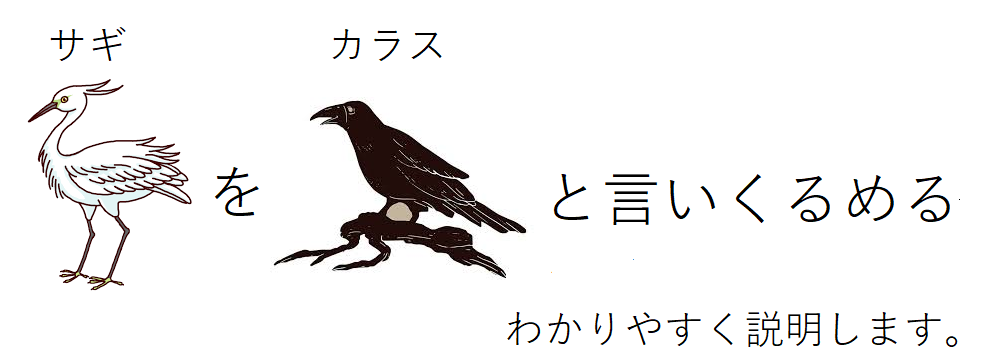
Are you familiar with the proverb, "To trick a heron into believing it's a crow" ?
One is a white bird, the other is a black bird. Even though they are both birds, they are clearly different. This proverb illustrates how one can forcibly distort the truth of things when it is clearly incorrect .
This article will provide a thorough explanation of the meaning, synonyms, usage, and English equivalent of the phrase "to talk someone into something."
In the second half of Princess Tutu, Rue, as the crow princess Kraehe, puts evil transformative raven-blood in Mytho, who is associated with swans, in an attempt to coerce him into ceasing to love the swan-princess Princess Tutu and make him fall in love with Princess Kraehe instead. This also turns him evil. When he tries to break free from the mind control/posession/brainwashing-like effects of the blood, Kraehe tells him that the "prince of the crows" is his true self, despite this obviously being untrue.
I... if I'm right that the swan/crow dichotomy in Princess Tutu is influenced by the preexisting heron/crow dichotomy in Japanese culture...


no subject
Date: 2026-04-04 07:32 am (UTC)